The legal landscape around AI voice cloning is shifting fast, and if you have been following the headlines, you could be forgiven for thinking the technology is becoming too risky to touch. Tennessee passed the ELVIS Act. Pennsylvania enacted Act 35. The federal NO FAKES Act is advancing. Regulatory pressure is building from multiple directions at once.
But here is what those headlines consistently miss: every one of these laws targets the same specific behavior, which is using someone else's voice without their permission. None of them restrict what you can do with your own voice when you hold the documented consent.
This analysis breaks down the actual legal text driving the compliance conversation, explains the authorization principle that runs through every current and proposed statute, and shows why professionals who clone their own voice today are not taking a legal risk. They are building a defensible, regulation-proof asset. You will learn what the ELVIS Act really prohibits, how Pennsylvania and the NO FAKES Act extend the same logic, and exactly how to document your consent so your AI voice twin stands on solid legal ground now and as regulation matures.
Why Voice Cloning Headlines Feel Threatening to Professionals
Search for "voice cloning" and the first results you find are not tutorials. They are warnings. Deepfake robocalls impersonating a presidential candidate. AI-generated audio of celebrities endorsing products they never touched. Recording artists suing platforms for replicating their voices without permission.
That coverage is accurate, and the legislative response it triggered is real. Tennessee enacted the ELVIS Act, making it the first state law to protect voice as an explicit property right. Pennsylvania's Act 35 followed the same logic. A federal proposal, the NO FAKES Act, would extend similar protections nationally. To a professional researching voice cloning software or voice cloning services for the first time, the headlines and legislation together send one clear signal: stay away.
That conclusion is understandable. It is also wrong, and closing the gap between perception and legal reality matters before it costs you a genuine competitive advantage.
Every law in this space, state or federal, targets the same specific act: using someone else's voice without their authorization. The technology is not the problem. The absence of consent is. A professional who clones their own voice with documented permission is not the subject of any current or proposed restriction. They are precisely the use case these laws were written to leave untouched.
The distinction between unauthorized cloning and consented self-cloning is not a loophole or a technicality. It is the organizing principle of the entire regulatory framework. The sections that follow walk through each law in plain terms so you can see exactly where you stand.
What the ELVIS Act Actually Says
Tennessee gave the clearest answer. That landmark law treats voice as an explicit property right.
What the law covers
The ELVIS Act defines "voice" to include both a person's actual recorded voice and any AI-generated simulation of it. That definition closed the loophole that previously let synthetic replicas slip through without legal protection. Your voice, real or cloned, is now a protected asset under Tennessee law.
Civil liability attaches in three situations:
Unauthorized commercial use of someone's voice for advertising, fundraising, or product promotion
Knowingly distributing an unauthorized voice replica in any medium
Distributing voice cloning AI tools whose primary purpose is producing unauthorized replicas
Criminal exposure is also real. Violations are classified as a Class A misdemeanor, carrying up to 11 months and 29 days in jail and fines up to $2,500.
The word that changes everything
Every liability provision turns on one concept: authorization. The Act does not prohibit voice cloning. It prohibits unauthorized voice cloning. A person who records their own voice, consents to the cloning process, and documents that consent is not described anywhere in this statute as a wrongdoer. They are the authorized party, by definition.
Self-cloning with documented consent sits entirely on the compliant side of this law. That distinction, authorization or the absence of it, runs through every piece of legislation that has followed Tennessee's lead.
Pennsylvania Act 35 and the NO FAKES Act: The Same Logic, Wider Reach
Tennessee was first, but it was not alone for long.
Pennsylvania's Act 35, signed into law by Governor Shapiro in 2025, addresses digital forgery. While the full statutory text is still being analysed by practitioners, early commentary places it in the same family as the ELVIS Act, targeting unauthorized rather than consensual use.
At the federal level, the proposed NO FAKES Act would extend federal protections against unauthorized digital replicas, though its specific provisions remain subject to amendment as it moves through Congress.
The pattern in every framework to date points toward consent documentation requirements rather than blanket prohibitions on voice cloning technology, a trajectory professionals can plan around today.
For professionals who work across state lines, this convergence is a practical advantage. A consent-documented self-cloning practice is already defensible under Tennessee and Pennsylvania law. Build it now, and it will almost certainly satisfy any federal standard that follows.
The Authorization Principle: What It Means for Non-Celebrity Professionals
Most commentary on these laws focuses on musicians and celebrities because their voices generate measurable revenue. That focus is understandable, but it has left a gap in guidance for everyone else.
The ELVIS Act states plainly that every individual holds a property right in their voice, regardless of fame. Courts have reinforced this, recognizing distinctive voices as protectable identity attributes with commercial value. A financial advisor whose clients recognize her voice, a consultant whose authority is built on years of recorded presentations, or a coach whose audience expects a particular delivery style all have a legitimate commercial interest in that asset. The law protects it.
Consent is the primary test, and it resolves the question immediately: if the person whose voice this is gave documented consent, no violation exists.
That makes professionals who clone their own voices the intended beneficiaries of these laws, not their targets. You own the voice. You initiate the cloning. You document the consent. Every element that triggers liability under the ELVIS Act and equivalent frameworks is absent from your situation.
For self-cloning with documented consent, the legal picture is already clear.
How to Document Consent for Self-Cloning: A Practical Checklist
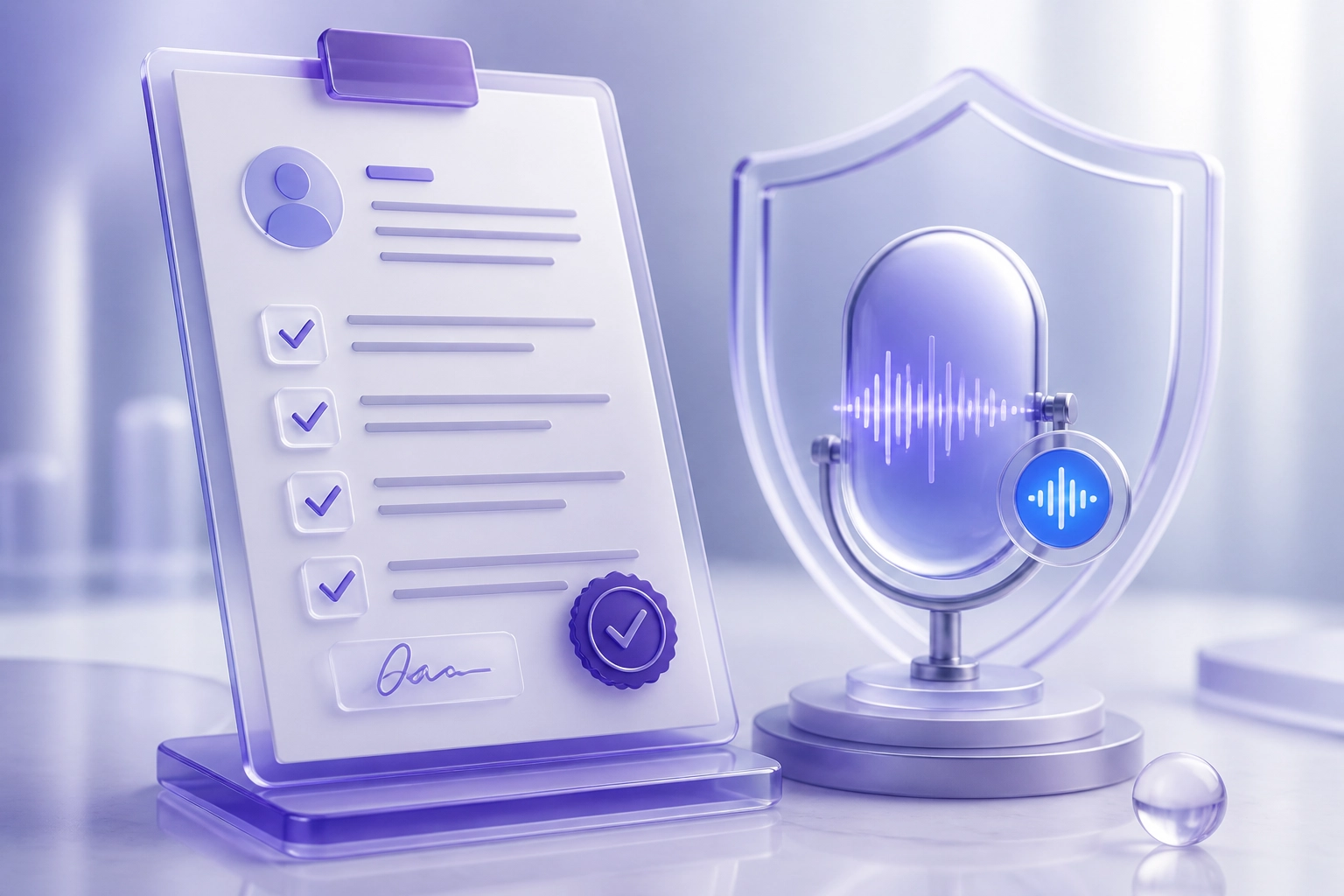
Knowing you are on the right side of the law is one thing. Being able to prove it, if anyone ever asks, is another. Six practical steps will build that proof.
Record your consent date and method. When you set up a voice cloning service or voice cloning app, note the date, the platform you used, and the specific terms you accepted. A brief entry in a dated document is enough.
Save a copy of the service terms. Download or screenshot the terms you agreed to, particularly any section covering how your voice data is collected, stored, and used. This links your consent directly to the content and twin provisions of the platform you chose, creating a clear paper trail.
Write a short authorization statement. State in plain language that the voice being cloned is your own and that you authorize its use for content creation under your personal brand. Sign it and date it. The ELVIS Act does not prescribe a documentation format, so a simple self-authored record is sufficient as best practice.
Log the content you produce. Keep a running record of each video or post where your AI voice appears. If a question arises about a specific piece of content, you can show it was produced from your own consented replica.
Follow each platform's AI labeling guidelines. Label twin videos as AI-made before you publish them. Transparency is consistent with the intent behind every current law and reduces any secondary concern for the platforms that distribute your content.
Schedule an annual review. The multi-state landscape is still developing. A brief yearly check confirms your records remain aligned with any new standards that have taken effect since you last reviewed them.
None of these steps requires legal expertise. Taken together, they turn your consent from an assumption into a documented fact.
Your Voice Is a Commercial Asset: The Business Case for Acting Now
That consent documentation gives you something concrete. Consider what it actually represents.
That statutory property right has a practical consequence: when you clone your voice with documented consent, you are building an asset you own and can defend.
That asset does practical work. Traditional video production costs time and budget most professionals cannot spare. A consent-documented AI twin produces consistent video presence across LinkedIn, Instagram, Facebook, and X without filming every week. The same voice, the same tone, the same credibility, on autopilot.
The first-mover advantage is real and underappreciated. Most professionals still believe the legal headlines and are waiting. While they wait, you can build months of voice-consistent content that compounds in reach and recognition. By the time competitors realize the legal risk narrative was never aimed at self-cloning, you will have a body of work they cannot replicate overnight.
Regulatory direction reinforces this. Every framework in development, from state laws to the proposed NO FAKES Act, converges on the same authorization principle. Consent documentation is the credential these laws were designed to reward. Your twin grows more defensible as the legal environment matures, not less.
For professionals in regulated industries, that matters in two directions. Financial advisors, lawyers, and healthcare providers who maintain explicit, dated consent records demonstrate that their AI content practice was built with the same rigor they apply to client work. Details on how your voice and face data are handled are covered in Brandios's privacy policy. That transparency is worth something, professionally and reputationally.
What Responsible AI Voice Cloning Looks Like in Practice
Knowing the legal framework matters. Putting it into practice is what protects you.
A responsible voice cloning workflow has three non-negotiable elements: you supply the voice yourself, you consent knowingly at the point of setup, and the platform records that consent. Without all three, you are in uncertain territory. With all three, you are exactly where the ELVIS Act and every law that follows it intends for you to be.
Brandios builds each of those elements into onboarding. You film one short phone clip, and that clip becomes your twin. Your face and your cloned voice are used only for content, and only after you have reviewed and approved it. Nothing publishes without your explicit go-ahead, given in the app or in a linked Telegram approvals chat. Each approval is a timestamped record of your ongoing authorization for that specific piece of content.
Transparency is built in from the other direction too. Twin videos are labeled as AI-made. Brandios recommends following each platform's own AI disclosure rules. That combination, consent at creation and disclosure at publication, aligns with the intent behind every current voice protection law and builds straightforward trust with your audience.
The result is a workflow where every hour you recover is covered by a clear paper trail. You own the voice. You approved each output. You can document all of it.
That is not a workaround. It is the standard the legislation was written to encourage. See what the workflow costs, or learn more about what a twin actually does before the next section explains why regulation is a reason to act, not to wait.
Regulation Is Not a Reason to Wait
That authorization principle, covered in detail above, applies consistently across every framework. Every law and proposal covered here targets the same behaviour: using someone else's voice without their permission. Not one of them restricts your right to use your own.
That distinction is not a loophole. It is the explicit design of each framework. Authorization is the legal dividing line, and a professional who records their own voice, documents their consent, and labels their AI content sits clearly on the right side of it.
The practical steps are short. Record your own voice. Keep a dated record of your consent and the platform terms you accepted. Label published content as AI-made, as each platform's guidelines require. Review your records once a year as new laws develop. Nothing on that list is complicated, expensive, or time-consuming.
Waiting for further legal clarity is understandable, but it is not necessary. The clarity already exists for anyone cloning their own voice with documented consent. Every current law and every proposal in development points to the same conclusion: consent is the answer, and you already own it.
If you want to see what a consent-documented AI twin looks like inside a real weekly content workflow, Brandios is free to try. No card required to start.
Meet your twin
Conclusion
The legal landscape around AI voice cloning is not as murky as headlines suggest. Authorization is the standard every law and proposal applies, and you already hold it for your own voice.
Three takeaways matter most. First, authorization is the legal standard, and you already hold it for your own voice. Second, the consent record you build today travels with you as the regulatory landscape matures. Third, waiting for more clarity means leaving a legitimate competitive advantage unused.
Your voice is a commercial asset, and the tools to protect and scale it exist right now. Record your voice, document your consent, and start building content that works without you present. The safe move is also the smart move.