Your voice is one of the most recognisable things about you, and now it can work even when you are not in the room. AI voice cloning has moved from science fiction into professional workflows, and UK professionals are right to pay attention, and right to ask questions before diving in.
This post demystifies exactly how the technology works. Not the marketing version, but the honest mechanics: what a 60-second audio clip actually captures, why that is enough to produce convincing output, and what happens to your voice data once it has been processed. You will also learn where the line sits between legitimate personal branding use and fraudulent misuse, what UK law and data protection rules require from you before you proceed, and what disclosure obligations you owe your audience under current regulations.
By the end, you will have a clear picture of realistic output quality, a step-by-step walkthrough of how the process works inside a personal branding tool, and a practical checklist to follow before you record a single word. Confident, informed adoption starts here.
What AI Voice Cloning Actually Does
When you record a short clip of yourself speaking, a voice cloning system does not store the recording to play back later. It analyses the audio and extracts a set of acoustic characteristics: your pitch range, your cadence, the shape of your vowels, the pace at which you naturally move between phrases, and the subtle tonal qualities that make your voice yours rather than anyone else's.
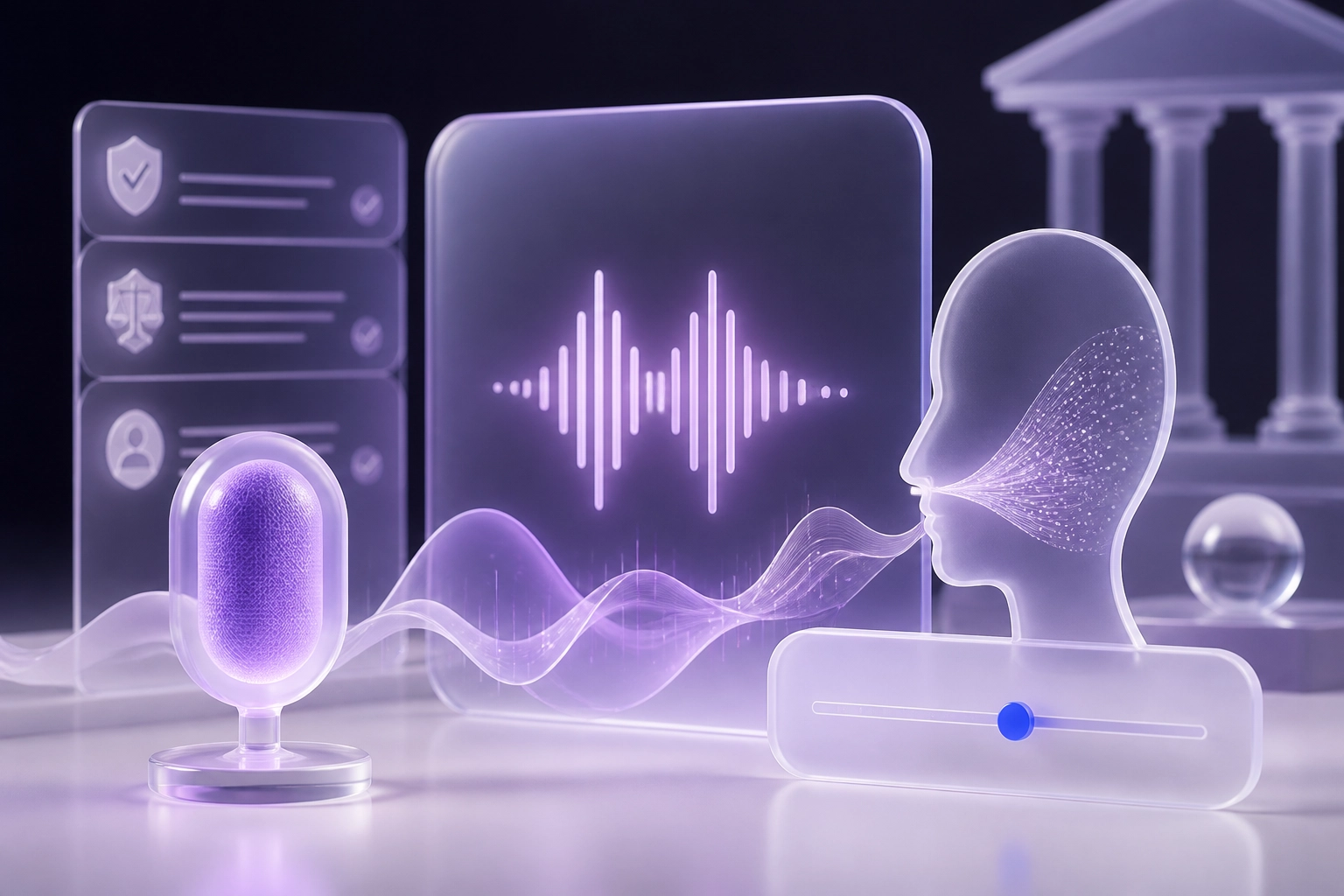
These characteristics are mapped into a voice profile. That profile is then used to drive text-to-speech synthesis. When new written content is fed into the system, the profile converts it into spoken audio that reflects your actual speech patterns, not a generic synthesised voice with your name attached.
No voice actor is involved. No soundalike is recorded. The system reproduces the specific acoustic fingerprint extracted from your real sample.
Research published in Current Psychology confirms that voice cloning preserves not only speaker identity but also prosodic style, meaning your accent, pace, and intonation transfer to newly generated content rather than being flattened into a uniform output.
The practical result is a voice model that can narrate content you have written and approved, in your register and at your natural pace, without you reading it aloud each time.
This matters for personal branding because your audience hears your rhythm and your tone. That is the difference between content that sounds like you and content that sounds like a machine reading a script.
The 60-Second Clip: What It Captures and Why That Is Enough
So you understand what the voice profile is. Now consider what it takes to create one.
A single 60-second recording gives the system enough acoustic data to work with. In that clip, it captures your frequency range, the pace at which you naturally speak, the way you shape vowels, and the rhythm of your sentences. These are the dimensions that make your voice recognisably yours.
Longer recordings can refine accuracy at the margins, but 60 seconds is the established baseline for legitimate personal branding applications. You do not need to record an hour of audio to get a usable result.
You also do not need any specialist equipment. The clip should be recorded in a reasonably quiet environment; no specialist equipment is required beyond what the platform's own guidance specifies.
Once recorded, the clip is processed to extract what you can think of as a voice fingerprint. The original audio is not stored for playback in your videos. The fingerprint, the mathematical model of your voice characteristics, is what drives all subsequent speech synthesis. You can review what data is collected and how it is handled before you record anything.
In Brandios, this same 60-second clip serves a second purpose. It does not just capture your voice. It captures your face too, so the system can produce your twin: short vertical videos featuring your face and your cloned voice, without any further filming on your part. One clip, recorded once, covers both. You can see how this fits into the broader package at brandios.ai/pricing.
Legitimate Voice Cloning Versus Fraudulent Use: The Critical Difference
That convenience comes with context you should understand before you record your clip.
AI-powered scams surged 1,210% in 2025, according to security researchers at Adaptive Security. Voice cloning sits at the centre of this threat. Criminals can clone a trusted voice in seconds and use it in so-called vishing attacks, where a familiar voice is used to authorise transfers, extract credentials, or impersonate a senior colleague.
The technology behind a fraud attack and the technology behind a legitimate personal branding tool are, technically, the same. The difference is consent and source.
Legitimate tools clone only your own voice, with your explicit agreement, for content you have approved. Fraud clones someone else's voice without any permission at all. That single distinction, who gave consent and whose voice was used, is what separates responsible use from a criminal act.
You cannot rely on your audience to spot the difference. Human detection of synthetic speech is unreliable. This means technical detection by listeners is not a workable safeguard. Transparent disclosure and proper governance are. You tell people your content uses a cloned voice. You keep control of every approval.
The risk compounds when a cloned voice is combined with synthetic video. These multimodal deepfakes are harder to question and harder to trace. Responsible tools require your explicit approval before any twin video publishes. Reviewing your content and your twin terms confirms exactly what controls you retain.
The technology is neutral. How it is used, and whether consent and transparency govern that use, is everything.
What UK Law Requires Before You Clone Your Own Voice
Consent and transparency are not just ethical positions here. They are legal requirements.
Under UK GDPR, you must give explicit consent before your voice is cloned, even when the voice is your own and the tool is acting entirely on your behalf. The fact that it is your voice does not remove the consent obligation.
Your voice sample may also qualify as special category data under UK GDPR, because it is processed using specific technical methods that allow unique identification of you as an individual. The ICO confirms that biometric data used for identification carries heightened protection requirements, with stricter rules around storage and processing.
Any tool or organisation processing your voice data must document the legal basis for doing so. If you are using a branding tool on behalf of a business rather than as a sole trader, you may also need to record that decision as part of your own compliance records.
If you work in a regulated sector, including law, financial services, or healthcare, check whether your professional regulator has issued guidance on synthetic voice in client-facing communications. Several have begun to address AI-generated content, and the position is evolving.
Before you record your 60-second clip, read the platform's data processing terms carefully. Confirm where your voice data is stored, who can access it, and how you exercise your right to deletion. These are not small-print details. They are the foundation of lawful use.
Disclosure Rules: What You Must Tell Your Audience
Consent gives you the legal foundation. Disclosure is what you owe your audience.
EU AI Act Article 50 requires that listeners are informed when synthetic or cloned voices are used in communications. If you publish to European audiences, or distribute content through European platforms, treat this as a live obligation now, not a future consideration.
Within the UK, dedicated AI transparency legislation equivalent to Article 50 is still in development. Even so, transparency is strongly advisable. Major platforms are moving toward requiring disclosure of AI-generated content, and best practice is to label proactively ahead of any formal requirement.
Practical disclosure is straightforward. A short note in your caption, your video description, or your profile bio is sufficient in most professional contexts. Something as simple as "This video was produced with AI assistance, including a cloned voice and AI-generated visuals" covers the essentials clearly and honestly.
For twin videos specifically, that statement should appear on every post, on every platform where you publish. A cloned voice combined with AI-generated visuals is precisely the content these disclosure frameworks are designed to address.
Hiding AI use is both a reputational risk and, in some contexts, a regulatory one. If your audience discovers it independently, the damage to trust will outweigh any short-term convenience. The stronger professional position is to be straightforward from the start. Audiences increasingly respect professionals who use new tools openly, rather than those who obscure how their content is made.
What to Expect from the Output: Realistic Quality Standards
Once you have addressed disclosure, the next question most professionals ask is practical: will it actually sound like me?
The honest answer is yes, with one qualification.
Modern voice cloning systems trained on real voice samples now produce speech that is, in controlled listener tests, as natural and intelligible as genuine recordings. A 60-second clip is enough to capture the key dimensions of your voice: your accent, your pace, and the way your intonation rises and falls. Where you may need a second pass is on unusual proper nouns, highly technical terminology, or speech patterns that are unusually fast. These are edge cases, not routine problems, but they are worth knowing about before you start.
The output sounds like you, not a generic synthesised voice, which is the distinction that matters for personal branding.
The formats standard to LinkedIn and Instagram are well within the operating range of current voice cloning systems, though reviewing the first outputs before full deployment remains good practice.
Before you approve anything for publication, watch the first few twin videos closely. In Brandios, the version of you that never stops posting only goes live after your explicit sign-off, which gives you a genuine quality check at every step, not just at set-up.
How the Process Works in a Personal Branding Tool
Knowing what good output looks like is useful. Knowing exactly how the process runs from clip to published video is what lets you decide whether to start.
In Brandios, that same 60-second clip from the earlier section becomes your twin, your face and cloned voice combined, so vertical videos can be produced without further filming.
Before any content is written, you build a brand profile. This tells the system who you are, who you speak to, which subjects you own, and what must never be said. The cloned voice then narrates scripts written to match your vocabulary and tone. Nothing is generic.
From there, get your hours back and keep the presence by letting the autopilot take over the weekly workload. It plans seven days of posts and twin videos, writes every piece in your voice, and sends each item to you for approval through the Brandios app and a linked Telegram chat.
No twin video publishes without your explicit approval. That single rule is the consent and quality control layer that separates responsible personal branding from automated content that bypasses your judgement entirely.
One further consideration for UK professionals: twins speak across 12 languages, including English in eight regional varieties. If your work takes you into European or international markets, your cloned voice travels with you.

Before You Start: A Practical Checklist for UK Professionals
Now that you understand how the process works, five practical steps will protect you before your first twin video goes live.
Read the data processing terms before you record anything. Confirm where your voice data is stored, who can access it, and how you can request deletion. Under UK GDPR, you have the right to erasure. The platform you choose should state this clearly, not bury it in footnotes.
Keep your own consent record. Most platforms capture consent digitally, but save a copy yourself: a screenshot or a dated note stating which tool you authorised, when, and on what terms. If you work in a regulated profession, this record matters if a compliance question arises later.
Decide your disclosure wording before you publish. A single, consistent statement that your videos are produced with AI assistance and a cloned voice is easier to manage than writing something new each time. Draft it once, then use it across LinkedIn, Instagram, Facebook, and X.
Check your regulator's current position. If you work in law, financial services, or healthcare, your regulator, whether the SRA, FCA, or GMC, may have issued guidance on AI-generated content in client-facing communications. Positions are evolving, so check directly rather than assuming silence means approval.
Start small. Approve and review a handful of twin videos before you activate full autopilot. This lets you confirm the voice output matches your expectations without committing to a full publishing schedule from day one.
The Honest Case for Voice Cloning in Personal Branding
Once you have worked through that checklist, the broader picture comes into focus.
As established at the outset, this technology scales your real voice, it does not fabricate a persona.
The risks covered earlier in this guide are real, but they are mitigated by the same three principles: explicit consent, transparent disclosure, and approval control.
UK professionals who approach this technology with informed consent and honest disclosure are in a stronger position, legally and reputationally, than those who adopt it quietly and hope no one asks questions. Transparency is not a burden here. It is a competitive advantage.
If you are ready to see how a single 60-second clip can become a consistent, professional social media presence, meet your twin at Brandios.
Conclusion
Voice cloning is no longer emerging technology; it is here, it is accessible, and UK professionals need to engage with it on informed terms. The principles in the checklist above are your foundation.
Done correctly, voice cloning does not compromise your authenticity. It extends it. Your real voice, your genuine professional register, reaches more people more consistently than manual recording ever could.
The professionals who will benefit most are not those who move fastest. They are those who move carefully, transparently, and within the legal framework the UK already provides.
You now have everything you need to make that decision with confidence. When you are ready to put it into practice, your twin is waiting at Brandios.